
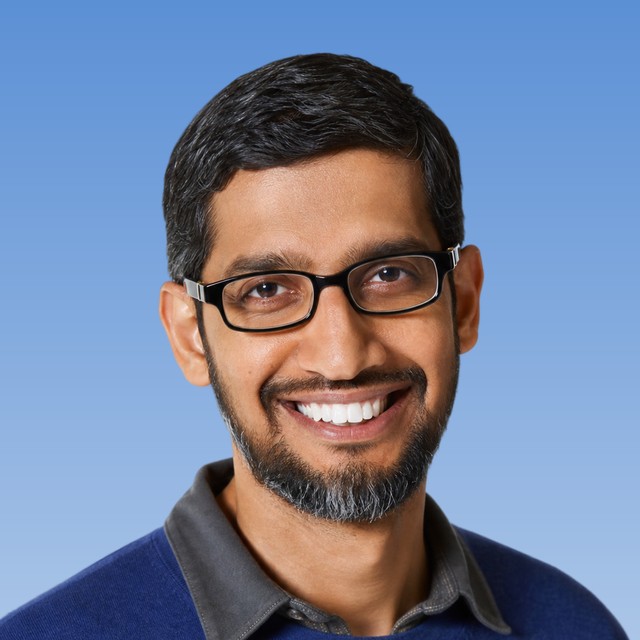
Sundar Pichai桑达尔·皮查伊
Google & Alphabet
CEO
 United States
Sundar Pichai, male, U.S. national, born June 1972 in Madurai, Tamil Nadu, India, began his career in 1995, holds a master's degree in materials science and engineering and an MBA. He is the chief executive officer of Google and Alphabet.
- 1989–1993Studied metallurgical engineering at IIT Kharagpur, earning a bachelor's degree
- 1993–1995Studied materials science and engineering at Stanford University in the United States, earning a master's degree
- 1995–2000Held engineering and product management positions at Applied Materials in the United States
- 2000–2002Studied as an MBA candidate at the Wharton School of the University of Pennsylvania, earning a master's degree
- 2002–2004Consultant at McKinsey & Company in the United States
- 2004–2015Served successively as vice president and senior vice president of product management at Google, leading businesses including Google Toolbar, the Chrome browser, and the Android system
- 2015–2019Chief executive officer of Google
- 2019–presentChief executive officer of Google and Alphabet
 Wikipedia · Sundar Pichai
Company
Full-stack model, TPU and cloud distribution.
Public event locations
- 3Jun 11, 2026 · GermanyGerman court holds Google liable for false AI Overview answers
- 2Jun 10, 2026 · South KoreaGoogle reportedly books Intel for packaging more than 3 million TPUs in 2028 — SK hynix is testing Intel's EMIB packaging for HBM integration
- 1Jun 6, 2026 · San FranciscoMicrosoft AI chief says company was “set free” from OpenAI to pursue superintelligence
Aggregates only locations that have appeared in public reports; locations, order and dates may be uncertain. The line and numbers indicate an inferred route only — not real-time positioning or current whereabouts.
Event timeline
Google researchers introduce 'faithful uncertainty', allowing LLMs to offer best guesses instead of hallucinations
In a new paper, Google researchers introduce 'faithful uncertainty,' a metacognitive technique that aligns a model's response with its internal confidence, allowing it to offer hedged hypotheses like 'My best guess is' instead of a binary answer-or-abstain. This helps autonomous systems determine when internal knowledge is sufficient and when to trigger external tools or search APIs. Current mitigation strategies expand knowledge boundaries but do not improve boundary awareness—the ability to distinguish known from unknown.
Google sues alleged Chinese cybercrime operation that used AI to send scam texts
Google has filed a lawsuit against a group called 'Outsider Enterprise,' accusing it of using AI to send scam text messages, reaching 2.5 million texts in two weeks and defrauding hundreds of thousands of victims. Google stated the group used AI to generate fake messages, luring users to click malicious links or provide personal information. This marks Google's first legal action against a cybercrime operation leveraging AI for mass fraud.
Google sues Chinese cybercrime network that used Gemini to automate scams
Google has filed a lawsuit against a Chinese cybercrime network that used its Gemini AI model to create fraudulent websites targeting hundreds of thousands of people. The scammers allegedly used Gemini-coded sites to impersonate legitimate services and steal personal information and money. This marks Google's first legal action against a criminal network exploiting its AI tools for large-scale scams.
Anthropic pursues data center leases, seeks financial backing from Google, The Information reports
AI firm Anthropic is planning to lease and manage its own data centers and is seeking financial backing from Alphabet's Google for the lease payments, The Information reported on Thursday. This move indicates Anthropic is ramping up infrastructure investment to support its AI model training and operations.
Surprise upset: GPT-5.5 beats Claude Fable 5 on brutal new Agents’ Last Exam benchmark
UC Berkeley's RDI and over 300 experts launched Agents’ Last Exam (ALE), a benchmark measuring AI's ability to execute economically valuable long-horizon workflows. OpenAI's GPT-5.5 topped the leaderboard with 24.0% pass rate, beating Anthropic's new Claude Fable 5 (22.0%). ALE aims to bridge academic benchmarks and real labor impact, showing top models still fundamentally fail.
Microsoft, like, totally gets why students are booing AI-pilled graduation speakers
Recently, at multiple U.S. college graduations, graduates booed speakers who hyped AI. Microsoft Vice Chair and President Brad Smith published a 3,100-word blog post addressing the phenomenon, calling for dialogue and understanding of students' concerns about AI.
German court holds Google liable for false AI Overview answers
A German court ruled that Google is liable for incorrect information provided by its AI Overviews feature. A recent study found that Google's AI Overviews regularly provide inaccurate information and contain facts not supported by cited sources. This ruling could have far-reaching implications for platform liability regarding AI-generated content.
Google reportedly books Intel for packaging more than 3 million TPUs in 2028 — SK hynix is testing Intel's EMIB packaging for HBM integration
After months of testing, Google has placed an order with Intel to package more than 3 million of its TPUs in 2028. Meanwhile, SK hynix is testing Intel's EMIB packaging technology for HBM integration. This marks a significant customer win for Intel's advanced packaging business and could reshape the AI chip supply chain.
NVIDIA Confidential Computing to Help Expand Apple’s Private Cloud Compute
Apple announced at WWDC that its Private Cloud Compute (PCC) will expand to Google Cloud, using NVIDIA GPUs for confidential inference. NVIDIA's confidential computing technology will support server-side inference for Apple Foundation Models, co-built by Apple and Google, aiming to enhance security and privacy in AI processing.
Apple’s new Siri AI is more than just a smarter assistant — it's a new enterprise app layer
At WWDC 2026, Apple unveiled a new Siri AI that becomes a systemwide AI interface for apps, data, and workplace actions. Enterprise developers can expose app content via App Entities and App Intents, allowing users to ask Siri to find, summarize, update, or act on app content without building a separate chatbot. This positions Siri as an AI-powered app action and content discovery layer.
On-device AI agents hit a hard memory limit. Apple's new architecture routes around it.
Apple announced third-generation foundation models AFM 3 at WWDC26, breaking on-device AI memory constraints. The 20-billion-parameter AFM 3 Core Advanced stores weights in NAND flash instead of DRAM, using per-prompt routing decisions to avoid token-by-token weight swapping. The family includes two on-device and three server-based models, with server models running on NVIDIA GPUs in Google Cloud and on-device architecture being Apple's own.
Anthropic brings Mythos to the masses with Claude Fable 5, its most powerful generally available model ever
Anthropic today launched two new AI models: Claude Fable 5 and Claude Mythos 5. Fable 5, the version for most users and developers, surpasses all previous generally available Claude models with stronger performance in software engineering, knowledge work, vision, scientific research, and long-running tasks. Mythos 5 is a restricted upgrade for approved users, including cybersecurity partners and select biology researchers. Fable 5 wraps Mythos-class capabilities in new safeguards, routing high-risk requests to Claude Opus 4.8. Over 95% of Fable sessions run on its own responses, with no universal jailbreaks found after 1,000+ hours of testing. Fable 5 is available to the public today; Mythos 5 initially only to existing restricted users.
Apple Downplays Concerns That Its Use of Google AI Models Will Undermine Privacy
Apple recently addressed privacy concerns over its use of Google AI models, emphasizing that its technical architecture ensures user data security. Apple stated that when integrating Google's AI models, it employs techniques such as on-device processing and differential privacy to prevent user information leakage. This move aims to balance AI feature enhancement with privacy protection, though some observers remain cautious about data sharing between tech giants.
NotebookLM’s new update will help you build source repository from chat
Google announced that NotebookLM will default to the Gemini 3.5 model and introduce a new feature allowing users to build source repositories directly from chat. The update aims to improve information organization efficiency, enabling users to extract and organize materials from conversations more conveniently.
NotebookLM’s Gemini 3.5 upgrade adds a cloud computer and help finding sources
Google is rolling out 'across the board' updates to NotebookLM. The AI-powered note-taking app now uses Google's upgraded Gemini 3.5 model, which will allow it to respond with 'more accurate and reliable information.' Launched in 2023, NotebookLM allows users to interact with their notes and sources using AI.
Let us filter AI slop, you cowards
The article calls on platforms like Google, YouTube, Meta, Instagram, and TikTok to allow users to filter AI-generated low-quality content (AI slop). The author criticizes these platforms for failing to provide effective filtering tools, forcing users to endure large amounts of AI junk. The article argues that platforms have a responsibility to give users more control to improve content quality.
Google signs $920M monthly compute deal with SpaceX — company’s projected annual data center revenue to exceed its combined proceeds from Starlink, launch services, and AI in 2025
Google has signed a $920-million-per-month compute deal with SpaceX, securing 110,000 Nvidia GPUs starting October 2026. This is the second data center deal for SpaceX in weeks, as it approaches its IPO on June 12, 2026.
Microsoft AI chief says company was “set free” from OpenAI to pursue superintelligence
Mustafa Suleyman, CEO of Microsoft AI, disclosed in an exclusive interview with VentureBeat that a contractual change with OpenAI about six months ago granted his division formal authority to pursue 'superintelligence' using Microsoft's own researchers, data pipelines, and custom silicon. This signals a strategic inflection point: Microsoft is not abandoning OpenAI but building alongside it, with its first in-house model family released the same day.
SpaceX Inks $30 Billion Computing Power Deal With Google
SpaceX has signed a $30 billion computing power deal with Google, under which Google will provide cloud computing and AI computing power to support SpaceX's Starlink satellite network and space exploration missions. The multi-year agreement involves Google Cloud infrastructure and AI technology, strengthening collaboration between the two companies in space and cloud computing.
Google to pay SpaceX $920 million a month for compute capacity at xAI data centers
Ahead of a planned IPO, SpaceX inked a deal to rent compute capacity to Google for $920 million per month for 32 months. The compute capacity comes from xAI data centers. The deal highlights the massive demand for AI computing resources among tech giants and SpaceX's expansion into AI infrastructure.
Google will pay SpaceX $920M per month for compute
Google and SpaceX announced a deal where Google will pay SpaceX $920 million per month for compute services. The agreement was disclosed one week before SpaceX's historic IPO, highlighting the growing collaboration between tech giants and aerospace companies.
SpaceX lands Google AI compute deal after Anthropic pact ahead of IPO
SpaceX said on Friday it has entered into a multi-year cloud services agreement with Alphabet's Google, locking in computing capacity as it prepares for its highly anticipated U.S. stock market debut next week. This follows a prior pact with AI firm Anthropic.
Google shuts down the AI image app Pixel Studio
Google announced the shutdown of its AI image generation app Pixel Studio, which launched less than two years ago. The app allowed users to generate images from text prompts, but Google decided to discontinue the service without specifying reasons. This move is part of Google's AI product adjustments, possibly involving resource reallocation or strategic refocus.
Google and FBI warn of ransomware group that sends fake IT workers to hack victims in person
Google and the FBI jointly warn of a ransomware group called Silent Ransom Group, which sends individuals posing as IT support staff to law firm offices to steal data using USB drives or remote access tools. Google's cybersecurity team identified this novel attack pattern and advises businesses to beware of such physical social engineering attacks.
The Fitbit Air is a good wearable weighed down by a chatty AI 'coach'
The Fitbit Air succeeds as a minimalist, reliable fitness tracker, but Google's integrated AI Health Coach feels unnecessary and annoying. The device performs well in tracking steps, sleep, and heart rate, but the AI coach frequently offers unneeded advice, detracting from the user experience.
Market reaction
The following is market reference information for related companies, and does not constitute investment advice.